






In This Article
- How a classic musical became a lens for understanding concentrated power versus human agency
- Why the American founding was a revolution that began unfinished
- What Reconstruction achieved, and how quickly those achievements were dismantled
- How political and economic democracy are two sides of the same coin
- What 2026 and 2028 are really deciding, and why it matters more than partisan politics
There is a strange thing that sometimes happens when you watch a movie you have seen several times before. You suddenly notice something that was there all along but somehow you never saw it. That happened to me recently while watching The King and I. I was expecting the familiar music, costumes, and spectacle. Instead, I found myself thinking about history and, before long, about America today.
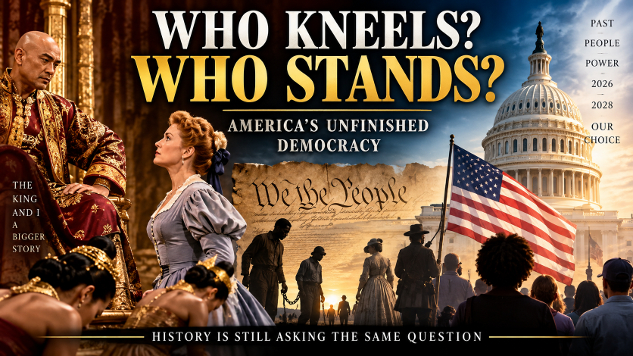
Everyone in that palace kneels before the King. It is the natural order, as old as the stone floors they kneel on. Then Anna arrives and simply refuses to kneel. Tuptim arrives as a gift and refuses, in her heart, to accept that any authority can convert a human being into property. The children of the court watch all of this with wide eyes, inheriting a world whose rules are suddenly being questioned. I stopped seeing an East-versus-West story.
I started seeing something much older and much closer to home, the ancient, unresolved conflict between concentrated power and human agency. And then I realized I was thinking about America in 2026. Democracy is not something a nation wins once and keeps forever. Every generation inherits it, and every generation can strengthen it, neglect it, or surrender pieces of it. America has taken steps backward before, sometimes with consequences that lasted generations. So the question that settled over me was no longer abstract: Are we watching one step backward before two steps forward, or are we watching the beginning of a much longer retreat from American democracy?
The Long Human Struggle to Stand Up
Pull the camera back far enough and the story of civilization is largely a story about machinery and who controls it. For most of human existence, many small-scale societies built strong informal mechanisms against the permanent accumulation of authority, mobility, sharing, social pressure, the simple ability to leave. That does not mean these were idyllic societies. Life could be brutal, and human societies have always differed enormously. But maintaining permanent inherited power becomes much harder when wealth cannot easily be accumulated and people retain the practical ability to pick up and leave.
Agriculture, permanent settlement, stored grain, inherited land, armies, and eventually bureaucratic states changed the structural equation. Civilization acquired increasingly powerful machinery, economic, military, administrative, and control over that machinery could become concentrated in fewer and fewer hands. The question that follows civilization like a shadow is the same one that echoes through every dynasty, every parliament, every constitution ever written: Who controls the machinery, and who must kneel before it?
America's Revolution Was Never Finished
The Declaration of Independence made one of the most radical assertions in the history of governance. All men are created equal. Governments derive their just powers from the consent of the governed. For 1776, this was genuinely explosive language. And then the Constitution arrived and began immediately qualifying it.
Enslaved people could not vote. Yet three-fifths of their population was counted for purposes of congressional apportionment and Electoral College strength, which meant the political power of enslavers was amplified by the very people they held in bondage. Non-enslaved women were counted fully in the population but overwhelmingly lacked the vote. Married women also lived under coverture, a legal doctrine that effectively folded their civic identity into their husbands'.
The distinction the founders never resolved is the one the country has been arguing about ever since: being counted is not the same as being represented, and being represented is not the same as possessing agency. American democracy was born unfinished. We the People did not mean everyone. Millions of people were governed by a political system in which they had little or no voice, while some were actually counted to increase the political power of those who denied them freedom. The American story since then has been a long and unfinished struggle over who gets to stand as a political equal, and who is still expected to kneel.

Reconstruction and America's First Real Attempt to Mean What It Said
Return to the palace for a moment. In The King and I, Tuptim stages a performance of Uncle Tom's Cabin and the layers are not subtle, she is a woman held as property, telling the story of people held as property, to an audience that includes the man who holds her. Her argument is elemental: no authority, however ancient, however confident of itself, can legitimately convert a human being into someone else's possession.
The chain of progression that flows from her rebellion is the spine of American democratic history. Property to person. Person to citizen. Citizen to voter. Voter to representative. Each step in that chain required a fight. None of them arrived as gifts.
The Civil War and the 13th Amendment ended legal slavery. But what happened immediately afterward was something more remarkable and more fragile. The 14th Amendment declared formerly enslaved people citizens and extended due process and equal protection. The 15th Amendment prohibited denying the vote on the basis of race. And then, in the years of Reconstruction, something genuinely unprecedented unfolded.
Black men in the South became voters, political organizers, city councilmen, state legislators, and members of the United States Congress. The country began, haltingly, imperfectly, with enormous continuing violence, to move from merely ending ownership toward creating actual political agency for people who had been written out of the republic's founding promise.
This was America's first serious attempt to make its founding language of equality apply institutionally to people who had been deliberately excluded from it. In little more than a decade, people who had been property became citizens, voters, lawmakers, and representatives. It was one of the greatest expansions of human agency in American history. It was two enormous steps forward. And then the country stepped backward.
1877 and the Step Backward That Lasted Generations
The 1876 presidential election was disputed in ways that make modern election controversies look tidy by comparison. The resolution, historians debate its exact nature and terms, and the full story is more complicated than any single narrative captures, ultimately placed Rutherford Hayes in the presidency and set in motion the withdrawal of federal troops from the remaining Reconstruction governments in the South.
Federal commitment to protecting Black political participation retreated. Southern white political control consolidated. Violence and intimidation came first and never entirely disappeared; poll taxes, literacy tests, grandfather clauses, and other legal barriers followed. Over time, the 15th Amendment remained in the Constitution while its promise was systematically denied across much of the South.
And here is the part of that history we rarely confront. After emancipation, Black Americans were no longer counted as three-fifths of a person for apportionment. They were counted fully. Yet once Black citizens were driven from meaningful participation in elections, their bodies still helped determine representation while other people largely exercised the political power that representation created. America had abolished the three-fifths formula without eliminating the older contradiction beneath it: people could still be counted without possessing meaningful agency.
That is why 1877 matters so much now. A democracy does not have to tear up its Constitution to retreat from democracy. The Constitution can remain in place, elections can continue, Congress can meet, and all the familiar institutions of representative government can appear to be functioning while ordinary citizens gradually lose some of their ability to control what those institutions actually do. America learned after Reconstruction that democratic progress is not irreversible. One step backward can last not four years, but generations.
Political Freedom Was Never the Whole Answer
Even as the fight for political agency continued through the 20th century, the 19th Amendment, the Civil Rights Act, the Voting Rights Act, the slow expansion of who was included in the word citizen, another argument was running alongside it. A citizen can possess a vote while possessing remarkably little power over the economic conditions governing everyday life. Industrialization generated enormous productive capacity and also generated concentrations of corporate and financial power that could shape the conditions of life as thoroughly as any government.
The Great Depression had multiple causes, and blaming it on any single economic failure would be too simple. But what followed transformed the relationship among government, capital, and labor. Social Security, financial regulation, collective bargaining rights, public employment programs, and eventually Keynesian economic management created counterweights to concentrated private power. Behind these reforms was a fairly simple recognition: the vote means less when economic power becomes so concentrated that ordinary people have little control over the conditions of their own lives. A citizen may possess one vote and still spend most of life dependent upon institutions over which that citizen has almost no influence. Workers had to stand too. Democracy could no longer mean only the right to enter a voting booth. It also had to mean enough economic security and bargaining power to live as something more than a subject of forces controlled by others.
America in 2026 and the Recurring Question of Who Gets to Stand
America has arrived at another of those moments when questions we once thought history had answered are being asked again. Across the country, states are changing the rules governing voting and election administration, sometimes expanding participation and sometimes restricting it, while conflicts over the boundaries of executive, congressional, state, and judicial authority are moving through the courts. Birthright citizenship has returned to active legal and political dispute, mass deportation has become a central federal policy, and the Justice Department says it is conducting the largest denaturalization effort in recorded American history. Perhaps most startlingly, an official Department of Homeland Security social-media post invoked an America after 100 million deportations, a number vastly greater than the undocumented population of the United States.
None of this makes 2026 another 1877, nor does it make today's circumstances equivalent to slavery or Jim Crow. History does not repeat itself with that kind of precision. What does recur is the old struggle over how much power people retain for themselves and how much they allow to accumulate above them. Who counts and who is represented have never been merely technical questions. Neither have who gets to vote, who possesses enough economic security to exercise meaningful independence, or even who is accepted as belonging within the political community. Ultimately, all of them lead to the same deeper question: Who gets to decide?
That question matters because democracy depends upon more than elections and constitutional language. It depends upon political power ultimately flowing from the people toward those temporarily entrusted to exercise it. The danger arises when that relationship begins to reverse, when increasingly consequential decisions about citizenship, representation, economic security, and individual rights move toward concentrated centers of power while citizens retain the outward forms of democracy but gradually lose some of their practical ability to shape what government does in their name.
This is where the lesson of 1877 becomes relevant again. The Constitution did not disappear when Reconstruction ended. The 14th and 15th Amendments remained exactly where they had been written, elections continued to be held, Congress continued to meet, and presidents continued to be elected. Yet millions of Americans gradually discovered that constitutional rights could remain on paper while the institutions willing to protect their ability to exercise those rights retreated. The outward machinery of democracy survived while democratic agency contracted.
That is the danger worth considering in 2026. Democracy does not have to disappear in a single dramatic moment to be diminished. It can retreat incrementally, through decisions that individually appear temporary or limited but collectively alter the relationship between the citizen and the state. America has traveled that road before, which is why the question facing us now is larger than any particular policy or election. Are we experiencing another step backward that will eventually provoke two steps forward, or are we at the beginning of a retreat whose consequences could last far longer than the people making these decisions today?
The Machinery You Help Build Does Not Always Stay Pointed Away From You
Political coalitions are built from people with different interests who agree to support concentrated authority because each group expects that authority to advance its particular concerns. Businesses expect deregulation. Industries expect protection. Political organizations expect institutional advantage. Constituencies expect that enforcement will be directed at someone else.
Tariffs offer a relatively straightforward contemporary example. Policies designed to protect certain domestic industries and satisfy certain constituencies can simultaneously raise costs for manufacturers, harm agricultural exporters, reduce options for consumers, and damage businesses whose supply chains cross the borders the tariffs were meant to fortify.
The people who supported the policy were not expecting to feel it themselves. But discretionary power does not come with a guarantee that it remains pointed in the direction it started. Power granted on the assumption that it will only be used against somebody else is still power. And power, once concentrated, tends to find new applications. This is not a partisan observation. It is a structural one, and history has made it repeatedly.
What 2026 and 2028 Are Actually Deciding
The 2026 midterm elections will determine control of Congress and therefore the character of the most significant constitutional counterweight to executive authority. The 2028 election will determine the presidency and the direction of executive power for the following four years. These are not small decisions. But these elections are about considerably more than which party wins. They are part of the much older argument running through this entire article about how much power ordinary people retain and how much they are willing to surrender.
Underneath the candidate names and the party labels lies the question this article has been building toward from the first paragraph. Will political and economic agency continue becoming more broadly distributed across the population? Or will increasingly consequential decisions, about who belongs, who votes, who works, who earns, who is protected, who is removed, become concentrated among fewer people and institutions?
And now we are building machinery the King of Siam, the American founders, and even the industrial barons could scarcely have imagined. Artificial intelligence, automation, and digital networks give us extraordinary new capabilities, but they leave us with the same old question: Who owns them, who controls them, and who benefits from what they produce? Every new level of civilization requires humanity to reinvent freedom. The question for this particular moment is whether technological abundance increases human autonomy or whether ownership of that abundance creates a concentration of power that makes every previous concentration look modest by comparison.
The Children Are Watching
Near the end of The King and I, I find myself thinking less about the King than about the children watching him. They have grown up inside a system whose assumptions seem as natural and permanent as the palace itself. People kneel because people have always knelt. Then Anna stands, Tuptim refuses to accept ownership, and suddenly the children are watching people question rules they had been taught were simply the way the world works.
Every generation inherits institutions it did not build and assumptions it did not choose. Americans today inherited constitutional government, voting rights, civil rights, labor protections, and other pieces of democratic infrastructure because earlier generations struggled over what kind of country they wanted their children to inherit. We did not create those institutions, but for a time they are entrusted to us.
For nearly 250 years, Americans who were expected to kneel have gradually stood. People who were property became persons with recognized rights. Persons became citizens, citizens became voters, and voters became representatives. Women who were expected to be spoken for demanded voices of their own. Workers who possessed little power individually learned to bargain collectively. More and more people gained the right to stand for themselves, although every one of those gains eventually had to be defended. Sometimes America moved two steps forward and one step back. As the retreat after Reconstruction demonstrated, sometimes the backward step lasted long enough to swallow generations.
That is the question confronting America in 2026 and 2028. Will this moment become another step backward before two steps forward, continuing the unfinished expansion of human agency, or will it mark the beginning of a much longer retreat? The children in The King and I inherited a world in which kneeling seemed natural until they saw someone stand. Our children will inherit whatever political and economic machinery we leave behind. The question is whether we leave them a democracy that still gives them the power to stand.
About the Author
 Robert Jennings is the co-publisher of InnerSelf.com, a platform dedicated to empowering individuals and fostering a more connected, equitable world. A veteran of the U.S. Marine Corps and the U.S. Army, Robert draws on diverse life experience, from real estate and construction to building InnerSelf.com with his wife, Marie T. Russell, bringing a practical, grounded perspective to life's challenges. InnerSelf grew from InnerSelf Magazine, founded by Marie T. Russell in 1985, which became InnerSelf.com in 1996. Decades later, InnerSelf continues to inspire clarity and empowerment.
This article is licensed under a Creative Commons Attribution-NonCommercial-NoDerivatives 4.0 License. You may share it with attribution to Robert Jennings, InnerSelf.com, and a link back to the original article at InnerSelf.com. Commercial use and derivative works are not permitted without permission.
Recommended Books
Reconstruction: America's Unfinished Revolution, 1863-1877 by Eric Foner, A landmark history of the post-Civil War era that reveals how thoroughly Reconstruction reshaped American democracy and how completely that reshaping was dismantled.
The Second Founding: How the Civil War and Reconstruction Remade the Constitution by Eric Foner, A concise and illuminating account of how the 13th, 14th, and 15th Amendments transformed the constitutional promise of equality and why those transformations remain contested today.
Democracy in Chains: The Deep History of the Radical Right's Stealth Plan for America by Nancy MacLean, A detailed examination of the intellectual and political movement that has worked for decades to limit democratic agency in the name of economic liberty.
Article Recap
The struggle between concentrated power and distributed human agency has defined American democratic history from the founding contradiction of the Constitution through Reconstruction, the Compromise of 1877, the long civil rights movements, and into the present disputes over voting access, executive authority, citizenship, and economic power. Understanding concentrated power versus human agency in American democracy means recognizing that constitutional text and democratic reality have never been automatically identical, and that progress in expanding who gets to stand has always been reversible. As the 2026 midterms and 2028 presidential election approach, the deepest question on the ballot is not a partisan one but a structural one: whether political and economic agency will continue broadening across the population or concentrate further among fewer people and institutions.
#HumanAgency #AmericanDemocracy #ReconstructionHistory #VotingRights #ConcentratedPower #DemocracyInAction #PoliticalHistory #CivilRights #ElectionsMatter #TwoStepsForward