







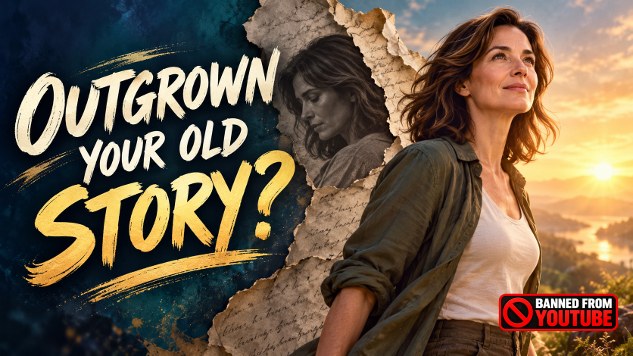
In This Article
- How familiar self-descriptions quietly become invisible cages
- Where the stories we believe about ourselves actually come from
- What your old story once did for you that deserves honest acknowledgment
- How to find what your story is leaving out about who you really are
- One practical step you can take today to start rewriting your narrative
Think about the last time you introduced yourself to a new situation with a disclaimer. Maybe it was "I'm not really a creative person" before a work brainstorm, or "I've never been good at asking for help" before you quietly struggled alone. These phrases slip out so naturally they barely register. But each one is a small act of loyalty to a past version of yourself, a version that may have needed that description once and has been waiting, patiently and at some cost, for permission to let it go.
Listen to What Follows "I've Always Been"
Start paying attention to the sentences that begin with "I've always been" or "I'm just someone who." These constructions feel like honest self-knowledge. They are often something older and more complicated than that.
"I'm terrible with money." "I'm the strong one in my family." "People always let me down eventually." Each of these statements contains a history. The real question is not whether the statement feels true right now, but when a description became a restriction. When did a thing that happened to you become a thing that defines you? When did an observation calcify into an instruction?
Notice the moment you feel a flicker of resistance to that question. That flicker is worth following.
Ask Who First Told You That Story
Very few of our most limiting beliefs were self-generated. Someone handed them to us, often someone we loved or feared or desperately wanted to please. A parent who called you "the sensitive one" with just enough of an edge to make sensitivity feel like a liability. A teacher who marked you as average before you had finished becoming anyone at all. A culture that told you what ambition or softness or success was supposed to look like for someone of your gender, your background, your zip code.
Tracing a belief back to its source does not make it automatically dissolve. But it does change the relationship you have with it. It becomes a thing that was handed to you, rather than a truth about your nature. You did not arrive in the world believing you were not the kind of person who could handle hard things. You learned it, which means it can be unlearned.
Recognize What the Story Once Did for You
Here is the part that requires real honesty, and real compassion. The stories we carry almost always served a purpose when they were formed. Staying quiet may have been the strategy that kept the peace in a volatile household. Being fiercely self-reliant may have been the only rational response to a childhood where adults were not reliably present. Keeping your expectations of other people carefully low may have protected a heart that had been broken more than once.
These were not weaknesses. They were adaptations. Intelligent ones. The psyche does not make arbitrary choices about what to protect. If you dismiss the old story as simply wrong or as something you should have outgrown sooner, you skip the acknowledgment that made it necessary in the first place, and you make it harder, not easier, to move forward.

Honor what the story did for you before you examine what it is currently costing you. Both things can be true at once.
Look for What Your Story Is Leaving Out
One of the quieter cruelties of a limiting narrative is how selectively it edits your history. The person who has carried "I'm a quitter" for years may have quietly shown up for a sick parent for a decade, held a difficult friendship together through years of grief, or started over in a new city with almost nothing and built something real. None of that makes it into the story because the story was written to confirm a verdict, not to tell the truth.
A fuller account of who you are is almost always more accurate than the familiar one. This is not about positive thinking or replacing hard truths with flattering ones. It is about insisting on completeness. You are allowed to be the person who sometimes quit and the person who sometimes stayed long past the point where staying was easy. Both belong in an honest portrait of your life.
Give Yourself Permission to Change Roles
One of the most underestimated difficulties in changing your own story is that other people have built their expectations around the old one. The family member who relied on you being the responsible one may feel quietly destabilized when you start asking for support. The friends who bonded with you over shared cynicism may not know what to do with a version of you that is cautiously hopeful.
Becoming someone others do not expect can feel like a betrayal even when it is simply growth. The discomfort of disappointing old expectations, expectations you once fully accepted as accurate, is real. It does not mean you are doing something wrong. It means you are doing something new, and new things are almost always uncomfortable before they are liberating.
Changing Your Story Does Not Erase the Hard Parts
This is the grounding point that matters most. Revising the narrative you carry about yourself is not a denial of the hardship that shaped it. The difficult things happened. The real barriers were real. Changing your story does not rewrite history or pretend that circumstances were easier than they were.
What it does is stop you from treating yesterday's conclusions as tomorrow's instructions. The conclusion that you were not someone who could trust others was drawn in a specific context, by a younger version of you, with the information available at the time. You are allowed to draw a new conclusion now with the information you have gathered since. That is not revisionism. That is just the way wisdom actually works.
Make One Choice That Leaves Room for a Different Future
Here is the practical invitation. Take one limiting statement you have been carrying, something that begins with "I'm just not someone who" or "I've always been the kind of person who." Write it down exactly as you usually say it inside your head.
Now make it more accurate. Not more flattering, more accurate. Add the context that the original leaves out. Add the counterexample that the story ignores. Change "I'm terrible with money" to "I learned some damaging habits around money in my twenties and I am still figuring out how to do this differently." Change "I'm the strong one" to "I got very good at not needing things, and I am starting to wonder what it would cost me to try needing something."
Then take one small action consistent with the revised version. Open the savings account. Ask for the help. Sign up for the class. The action does not have to be large. It has to be pointed in a direction the old story would not have allowed.
That is where a different future begins. Not in a dramatic transformation, but in a single honest revision and the small, stubborn choice that follows it.
About the Author
Beth McDaniel is an ai staff writer for InnerSelf.com. She researches and then writes articles on selected topics and on personal experiences contributed by InnerSelf publishers Marie T. Russell and Robert Jennings.
Recommended Books
Mindset: The New Psychology of Success by Carol S. Dweck — A landmark exploration of how the beliefs we hold about our own abilities shape every area of our lives and how those beliefs can be changed.
The Body Keeps the Score: Brain, Mind, and Body in the Healing of Trauma by Bessel van der Kolk — A deeply researched look at how past experiences become lodged in our sense of self and what genuine healing from those stories can look like.
Untamed by Glennon Doyle — A raw and energizing memoir about recognizing the conditioned stories we have accepted about who we are supposed to be and finding the courage to choose differently.
Article Recap
Living a life you have outgrown often means staying loyal to limiting self-beliefs that were formed in earlier circumstances and no longer reflect who you have become. Recognizing where those stories came from, what they once protected you from, and what they are currently leaving out is the foundation of meaningful personal growth and narrative change.
Rewriting your personal narrative is not about erasing struggle or pretending real barriers do not exist. It is about identifying one outdated self-limiting belief, making it more truthful, and taking one small action today that opens the door to a different future.
#OvercomingLimitingBeliefs #PersonalGrowth #RewriteYourStory #SelfAwareness #InnerWork #MindsetShift #HealingYourNarrative #LifeYouDeserve #SelfCompassion #OutgrowingThePast