






In This Article
- What drives the need for attention over love?
- How does society contribute to distorted expressions of love?
- What methods can cultivate positive attention in youth?
- How can communities apply love to combat social issues?
- What are the potential risks of neglecting emotional needs?
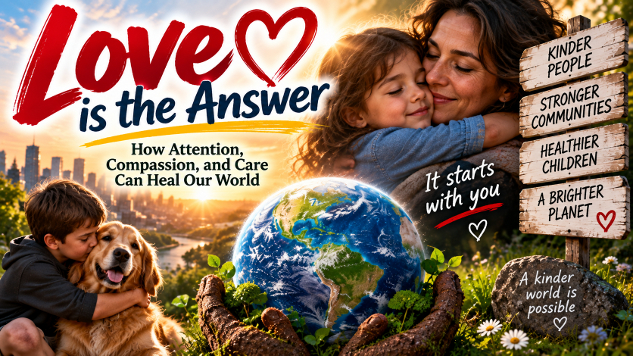
Everyone's basic need is to love and be loved. From the baby to the elderly, everyone wants love — even the animals and the planet. As I look around me, especially when I look at what's happening in world events, I realize that this basic need has somehow become distorted.
The need for love has been translated by some into the need for attention. When we were children, the people who loved us also paid attention to us. They listened to us, held us, fed us, comforted us, smiled at us, and noticed us. So it is perhaps natural that we learned to interpret receiving attention as being loved.
But attention and love are not necessarily the same thing.
What happens when people are starved for love, connection, acceptance, or simply the feeling that they matter? They may go out and try to get attention. Some may do that by becoming prominent in a constructive way, perhaps through theater, sports, music, their profession, community service, or simply excelling at their job.
Others may seek attention in ways that are destructive to themselves or to others. They may act out, bully, lash out in anger, or in extreme cases turn to violence and crime. When people feel invisible, rejected, humiliated, or disconnected, the need to somehow be seen and acknowledged can become very powerful.
And we now live in a world where attention itself has become a commodity.
Social media counts our likes, followers, shares, views, and comments. News organizations compete for our attention. Advertisers compete for our attention via purchases. Politicians compete for our attention translated into votes. Influencers make their living from attention and clicks. Algorithms learn what will keep us watching, clicking, reacting, and coming back for more.

Somewhere along the way, we may have begun confusing being noticed with being valued, and being seen with being loved. Yet they are not the same thing.
Gone are the days when we can simply sit and shake our heads at how terrible the world has become, bemoaning the youth of today, the politicians of today, the media of today, or society in general. We are part and parcel of that world.
If it has "gone downhill," we are also participants in the society that created it. We have contributed to a culture that sometimes turns children over to television, phones, video games, and social media for much of their entertainment, education, and even their understanding of human behavior and relationships.
We watch programs, movies, videos, and news stories that sometimes turn destructive behavior into spectacle. We click on outrageous headlines. We share shocking stories. We repeat the names of people who commit terrible acts. And social media can magnify all of this within minutes, rewarding whatever generates the strongest reaction.
Without intending to, we may be teaching that one of the surest ways to be noticed is to do something outrageous. There are no completely innocent bystanders here. We are all, in one way or another, part of the show.
What About Violence and Anger?
So what can we do about the violence, anger, alienation, and destructive behavior we see around us?
My answer is: Pay attention! But perhaps not in the way we have been doing it.
When we focus endlessly on the crime, the violence, the outrage, or "how terrible it is," we may unintentionally give destructive behavior exactly what it was seeking: attention.
This does not suggest we ignore harmful behavior, nor does compassion mean excusing it. People must be responsible for their actions, especially when those actions harm others.
But perhaps we also need to ask what happened before the harmful behavior occurred. Did that person feel invisible, unwanted, rejected, or convinced that nobody cared whether they existed? What if someone had paid attention earlier?
We need to start paying attention to children and youth before they feel they must do something extreme to be noticed. We need to let them know they matter before they begin measuring their worth by likes, followers, popularity, notoriety, or the reaction they can provoke from others.
And perhaps we need to do the same thing for adults.
There is no need to look down upon people who have lost their way or who have learned unhealthy ways of seeking attention. We can hold people accountable for their actions while still recognizing the human being underneath the behavior.
We can reach out when possible. We can demonstrate, through our caring and loving actions, that there is another way to be seen and acknowledged. We can help people discover that attention backed by love is much more fulfilling, rewarding, and long-lasting than attention fueled by fear, anger, rejection, or outrage.
What Can You and I Do?
If we believe in living consciously and compassionately, then we need to take action — positive action.
Contact your local schools and see what organizations need volunteers. Donate your time to youth centers. Offer used books to prison libraries. Help organize activities where children and teenagers can experience cooperation, creativity, belonging, and the satisfaction of contributing something worthwhile.
Ask teachers, coaches, parents, community organizations, and local leaders: How can we start giving children supportive attention now? How can we help create a society where people don't have to become outrageous, destructive, or famous simply to feel that they matter?
Let's provide opportunities that support the development of self-esteem, self-respect, and self-love in children and young adults. As they learn to respect and love themselves, they are more likely to extend that respect and caring to other people and to the world around them.
And let us also remember the adults. Look around you and see how you can share your love and attention with those who need it.
Sometimes a simple smile can make a world of difference. Someone who didn't think they mattered may feel differently because you took the time to stop and chat, really listened to what they had to say, or simply acknowledged their presence.
Perhaps it means calling someone who lives alone. Perhaps it means putting down your phone when someone is talking to you. Perhaps it means looking the cashier in the eye and saying thank you. Perhaps it means telling someone that you noticed the effort they made.
These are such small things. Yet perhaps they aren't small at all.
When we give someone our genuine attention, we are saying: I see you. You matter. You are here, and I recognize your presence in my world.
And perhaps that is one of the simplest ways love expresses itself.
Love Is Still the Answer
There is one commodity that we all have an abundance of — love. It's free, and it comes in an unlimited supply. Love is ours to give.
It is a powerful healer of emotional wounds. It answers one of our deepest needs — the need to know that we matter, that we belong, that someone sees us and cares.
Let's share our love with those who need it — and don't we all? — and watch love grow. We may be surprised at the transformations that can happen.
It is up to you and to each one of us. We are the light bearers. Let us shine our light where it is needed — in the dark corners, in the gutters, in the lonely places, and in the hearts of those who need it the most.
It is wonderful to love other light bearers. That is easy. The greater challenge may be loving those whose light has become difficult to see. It does not mean approving of everything they do. It does not mean allowing ourselves or others to be harmed.
It simply means remembering that underneath the anger, fear, loneliness, or confusion, there is still a human being who needs what every human being needs: To love and to be loved.
So let's go out and plant some seeds of light where they are greatly needed.
And then let's watch the world light up.
About The Author
 Marie T. Russell is the founder of InnerSelf Magazine (founded 1985). She also produced and hosted a weekly South Florida radio broadcast, Inner Power, from 1992-1995 which focused on themes such as self-esteem, personal empowerment, and well-being. Her articles focus on transformation and reconnecting with our own inner source of joy and creativity.
Creative Commons 3.0: This article is licensed under a Creative Commons Attribution-Share Alike 4.0 License. Attribute the author: Marie T. Russell, InnerSelf.com. Link back to the article: This article originally appeared on InnerSelf.com
Further Reading:
-
All About Love: New Visions
Examines love not simply as an emotion but as a practice involving care, responsibility, respect, trust, and commitment. Her perspective invites readers to consider how consciously choosing loving actions can transform relationships, communities, and the way we respond to people who feel unseen or disconnected.
Amazon: https://www.amazon.com/exec/obidos/ASIN/0060959479/innerselfcom
-
The Power of Showing Up: How Parental Presence Shapes Who Our Kids Become and How Their Brains Get Wired
Daniel J. Siegel and Tina Payne Bryson examine how consistent emotional presence helps children develop security, resilience, and healthy relationships. Their work emphasizes the importance of helping children feel safe, seen, soothed, and supported rather than assuming that material care alone satisfies their developmental needs.
Amazon: https://www.amazon.com/exec/obidos/ASIN/1524797731/innerselfcom
-
The Boy Who Was Raised as a Dog: And Other Stories from a Child Psychiatrist's Notebook--What Traumatized Children Can Teach Us About Loss, Love, and Healing
Bruce D. Perry and Maia Szalavitz use clinical stories and developmental neuroscience to examine how neglect, trauma, fear, and human relationships affect developing children. The book also demonstrates the importance of safety, patient attention, supportive relationships, and compassionate connection in helping damaged lives heal.
Amazon: https://www.amazon.com/exec/obidos/ASIN/0465094457/innerselfcom
Article Recap
Nurturing love and attention in communities can prevent negative behaviors in youth and foster a more compassionate society. Taking proactive steps to engage with those in need is essential for healing and transformation.
#InnerSelfcom #CommunityEngagement #YouthDevelopment #EmotionalHealing #SocialResponsibility #PositiveAttention